


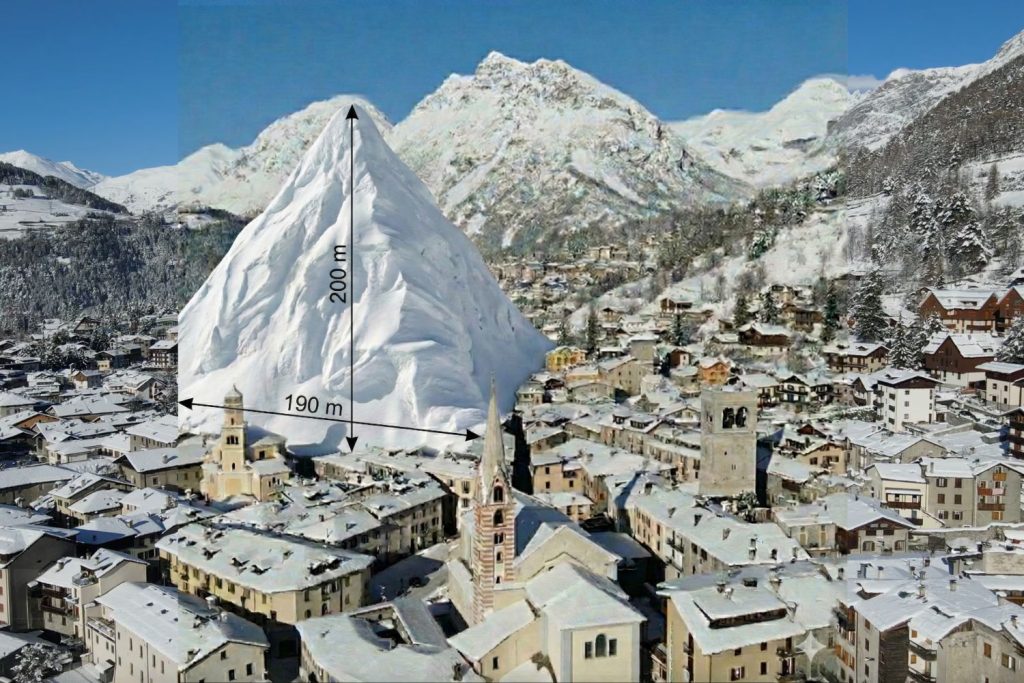
With the Winter Olympics 2026 in Milan Cortina less than a week away, one of its most tangible and controversial symbols is the colossal amount of artificial snow required to guarantee events worthy of the name. The Olympic organizing committee has planned to produce no less than 2.4 million cubic meters of artificial snow. This represents a volume comparable to the Great Pyramid of Giza, Egypt: a pyramid 200 meters high and 190 meters wide. This amount of artificial snow requires nearly one million cubic meters of water.
The Olympics are no longer made, and will no longer be made, without a very large quantity of artificial snow. What was valid for the Beijing Olympics (where the air is cold but the climate dry in winter) is unfortunately valid for the Cortina Olympics (where the vagaries of the climate do not guarantee snow cover). To ensure homogeneous competition surfaces, the organizing committee of Milano-Cortina 2026 has planned to produce about 2.4 million cubic meters of artificial snow, requiring nearly 948,000 m3 of water, including 580,000 m3 only for the site of Livigno Mottolino — the Olympic snowpark with half-pipe and Big Air.
These figures, certainly lower than those mobilized during the 2022 Beijing Games (where more than 2.7 million cubic meters of water were used for snow), remain extraordinary.
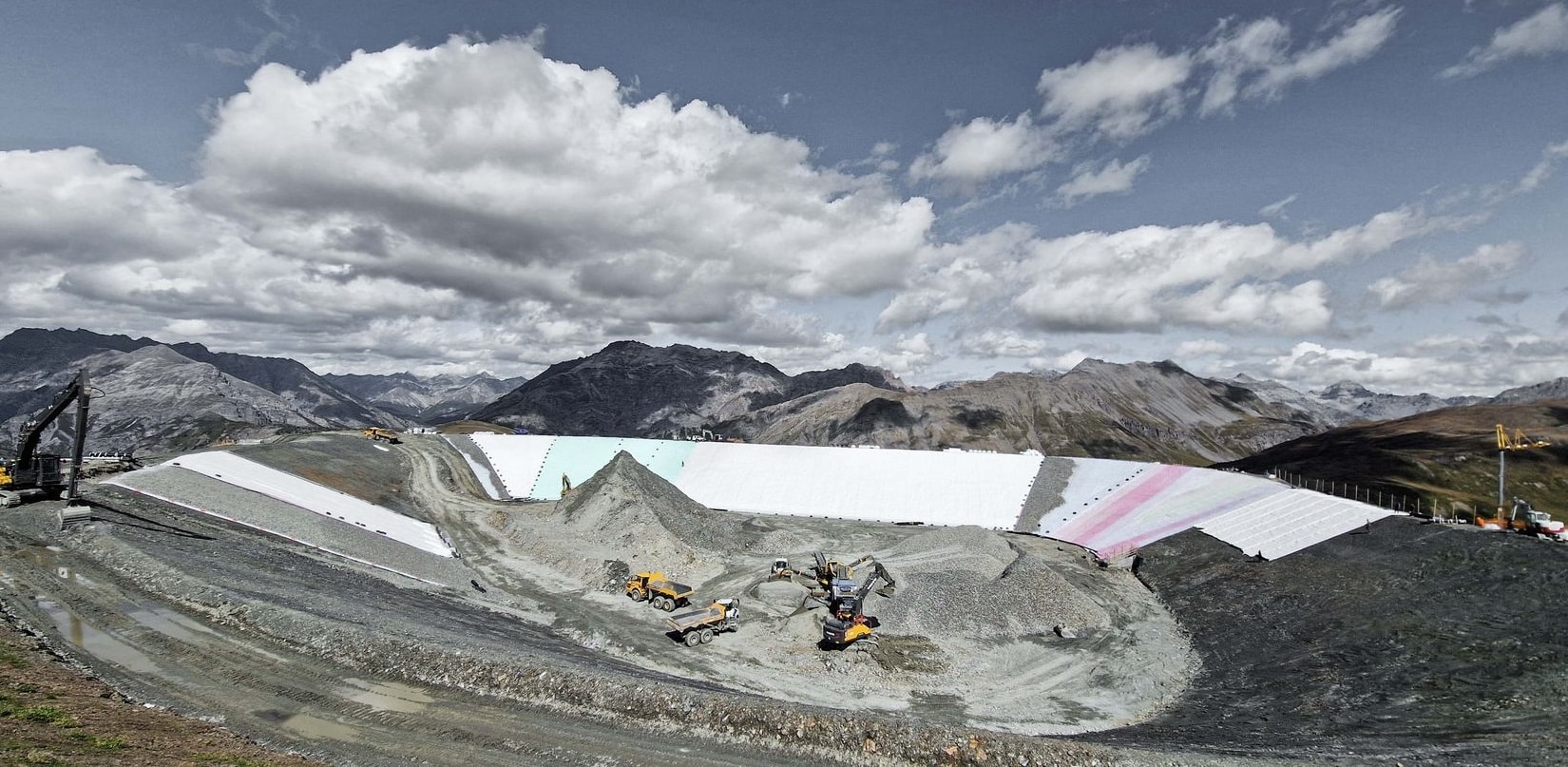
In Livigno, this new construction has a capacity of 210,000 m3 of water at an altitude of 2,530 m. Source : Techno Alpin
The use of artificial snow is no longer the exception but has become the rule for major international events. The international ski and biathlon federations impose slope standards—in terms of density, uniformity and resistance — difficult to achieve with natural snow cover, especially in a context of global warming where the reliability of snowfall decreases even at altitude.
In the Dolomites that will host the alpine events, a very large part of the slopes will be covered by mechanically produced snow, which also ensures the safety of the athletes and the fairness of the competition.
Behind this massive deployment of artificial snowmakers, and the magic of the event, are hidden an important energy consumption, water withdrawals in winter period and facilities that damage the landscape of the Dolomites. The local opposition and environmental associations are already denouncing “the enfolding of the mountain” and the impacts on alpine ecosystems.
The use of artificial snow is no longer the exception
but has become the rule for major international events
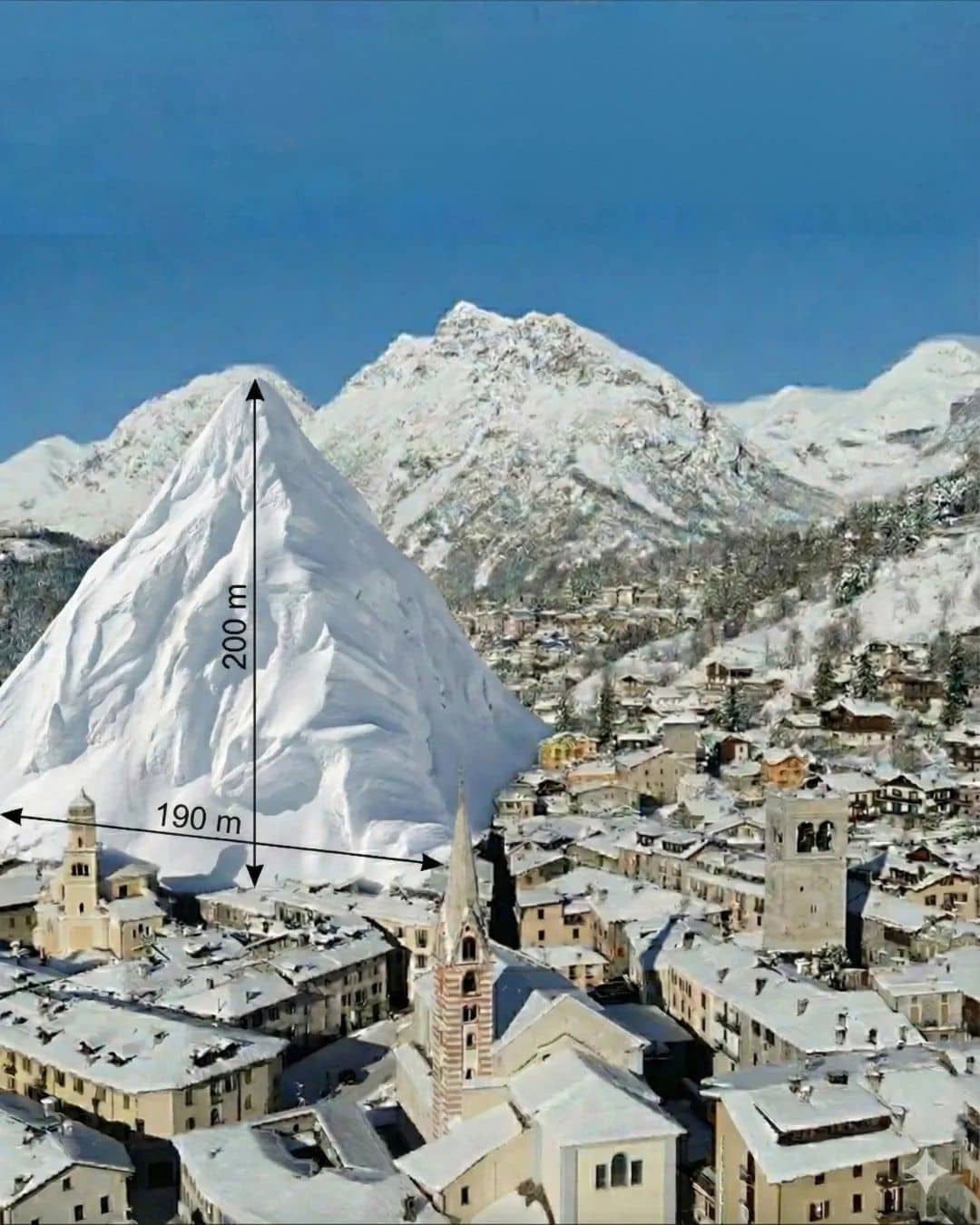
©Occhio del Gigat.
Beyond the numbers, some Italian observers – like the internet page Occhio Del Gigat – wanted to give an even more visual scale to this mass of artificial snow: these 2.4 million cubic meters are comparable to the volume of the Great Pyramid of Giza, Egypt.
Be a pyramid whose base (one side) is 190 meters, for a height of 200 meters. Certainly, the Egyptian pyramid is a little larger (2.59 million m3), but appreciably of the same size.
If the electrical energy used to produce snow will be 100% renewable, thus avoiding the release of 504 tons of CO into the atmosphere, the amount of water can be estimated at the annual consumption of an average city like Sondrio (20,000 inhabitants).
This water is either taken directly from mountain streams (as in Cortina) or stored in hill reservoirs (as in Livigno).
The Milano-Cortina 2026 Olympics could well be one of the last major sporting events where we see such a deployment of cultural snow in the Alps… until the 2030 French Alpine Olympics?