



It is a cruel irony. 240 years ago, Jacques Balmat and Michel-Gabriel Paccard reached the summit of Mont Blanc for the first time. On the 8th of August, 1786, after years of attempts, the impossible became possible. A mountain that had until then been viewed only from the valley made history. 1786 marked the birth of mountaineering—with the exception of Mont Aiguille, of course.
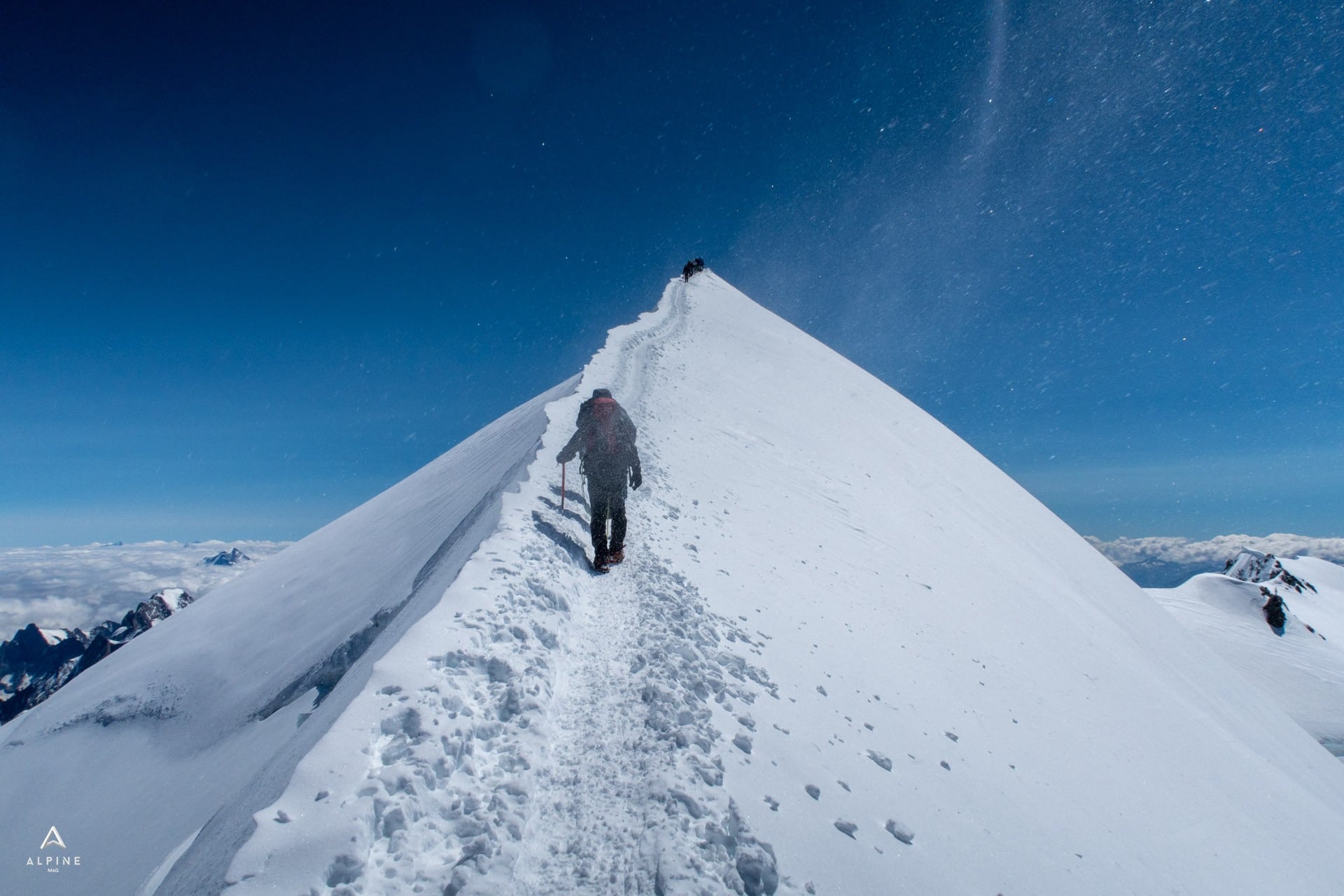
Au sommet du mont Blanc. ©Ulysse Lefebvre
Moreover, the Grands Mulets mountain hut has not been staffed since the 31st of July, and the Gonella mountain hut, on the Italian side of the Miage, has not been staffed since the 24th. As for tackling the major routes on the Italian side – Brenva, Frêney, Brouillard – with the isotherm at over 4,000 metres, it’s tantamount to playing Russian roulette – not to mention the dreadful state of the glaciers on the approach routes.
The other main routes are no fallback option either
The irony of the story is striking. Balmat and Paccard had no idea how to climb Mont Blanc. We have guidebooks. We have weather forecasts, mountain huts, ice axes, crampons, and two centuries of accumulated experience. And yet, we remain in the valley.
In 1786, Mont Blanc was impossible because it was unknown. In 2026, it will become so—at least for a time—because climate change is a reality. And because we know it is better not to go there.
This may well mark one of the major shifts in our relationship with the mountains, and with the most famous peak in the Alps. For a long time, ‘progress’ seemed to be constantly pushing back the boundaries. Better equipment, more accurate weather forecasts and carefully mapped routes made the peaks more accessible. Today, this trend is coming up against the rapid transformation of the high mountains.
‘Progress’ – along with its tunnels, lorries and overtourism (hello, UTMB!) – is coming back to haunt us like a boomerang.
The glaciers look terrifying, and rockfalls are becoming more frequent, as at the Aiguille du Midi, where an estimated 15,000 cubic metres of rock collapsed in a single event. Simply saying that one must love the ‘dark mountains’ rather than picture-postcard landscapes won’t be enough.
accepting that Mont Blanc may have to be admired from afar
Mont Blanc is the most spectacular symbol of this. This peak, which thousands of people climb every year, can, in the middle of August, find itself without any truly passable route.
For two centuries, the history of mountaineering has been about making the seemingly impossible possible. No doubt we must now learn to do the opposite: to recognise that what was possible yesterday is not – or is no longer – possible today. To accept, at times, that we must view Mont Blanc from afar. Or from other peaks!