


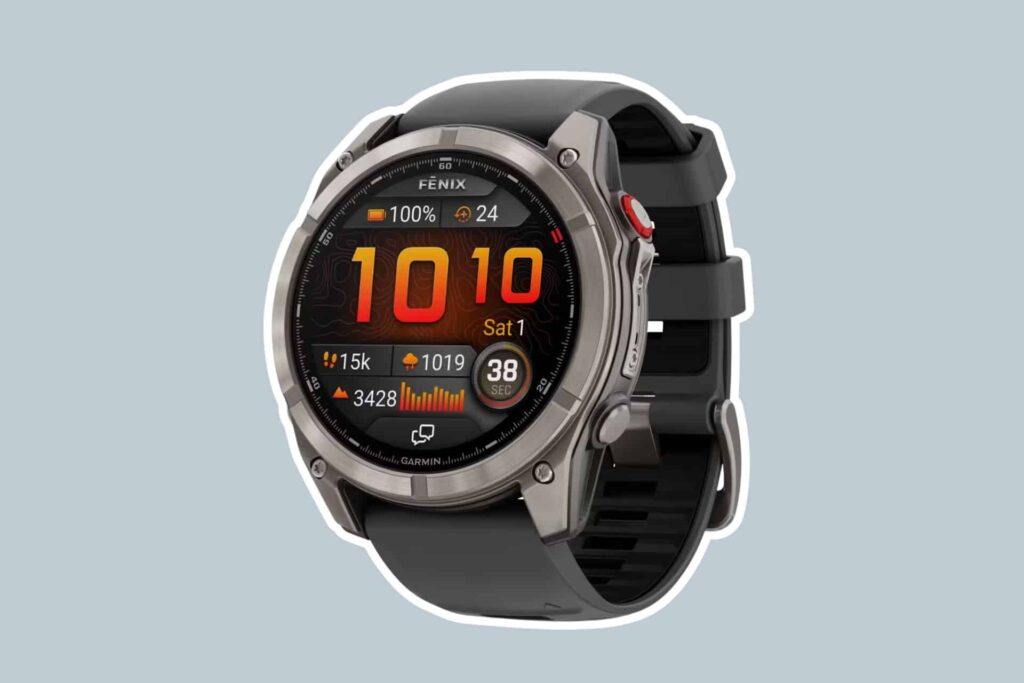
The Garmin fēnix 8 Pro takes almost everything from the fēnix 8, but adds what the range was still missing: real communication capability without a smartphone. LTE, satellite, messages, position sharing, SOS: Garmin brings its outdoor watch closer to the inReach universe.
To put it simply, a fēnix 8 Pro is a fēnix 8 with a built-in inReach beacon. The same sports tool, the same high-end outdoor watch logic, but with the added ability to send messages, share your location, or trigger an SOS when your phone no longer has coverage. The question is whether this integration really changes the way we use the watch in the outdoors, and whether you actually need it.
a fēnix 8 Pro is a fēnix 8 with a built-in inReach beacon
The fēnix 8 Pro keeps the fundamentals of the range: onboard mapping, GPS, sports profiles, LED flashlight, rugged case, touchscreen, physical buttons, health tracking, training data, navigation, music, and contactless payment. It also keeps the usual drawbacks of this family: a bulky format, sprawling menus, a high price, and a density of features that takes some learning.
The real novelty lies elsewhere. For the first time on a fēnix, Garmin has integrated inReach technology directly into the watch, with two communication modes: LTE when mobile network coverage is available, and satellite when it is not. The goal is clear: to let you head out without a phone, or keep a communication option when the phone becomes useless because there is no signal.
On paper, this looks like a small revolution for outdoor users. In the field, it is more nuanced. The fēnix 8 Pro brings real safety, but not absolute safety, and probably not the same level of reliability as a dedicated beacon. It allows you to communicate, but within Garmin’s closed ecosystem.
An upgraded fēnix 8
Anyone already familiar with the fēnix 8 will feel at home. The Pro follows the same philosophy: a solid, dense watch designed for both training and long days out. You get TopoActive maps, turn-by-turn navigation, trail running, cycling, hiking, skiing, mountaineering, swimming, diving, triathlon, strength training, and even yoga profiles.
The multiband GPS remains accurate. In the forest, in the city, the track is clean. Not perfect — no watch is — but reliable enough to analyze an outing or follow a route without constantly wondering whether you are on the right path.
Mapping remains one of the range’s strongest arguments. On an unfamiliar itinerary, the watch lets you follow a track, anticipate a change of direction, and check a junction. The touchscreen helps when moving around the map, but the buttons remain essential as soon as it rains, snows, or you are wearing gloves.
Garmin also keeps its very comprehensive approach to training. Load, recovery, HRV, training status, endurance, hill score, daily readiness, workout suggestions: it is all there. The fēnix 8 Pro is therefore not more of a sports watch than a fēnix 8. It will not help you run faster, nor does it transform navigation. Its difference answers a simple question: what happens when you no longer have a phone?
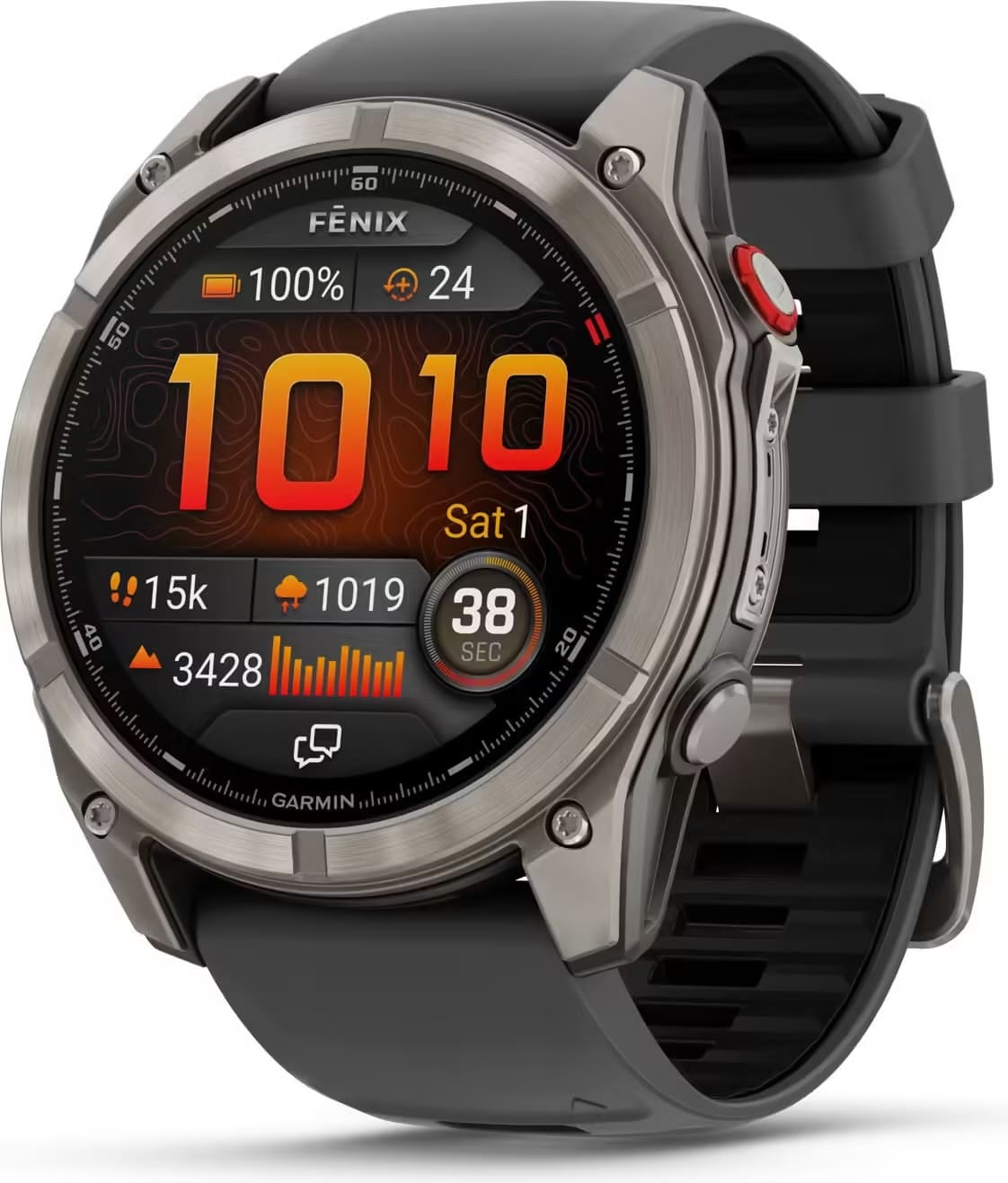
Fenix 8 Pro.
Phone or no phone
The built-in LTE can be misleading. The fēnix 8 Pro is not a general-purpose connected watch that gives you your phone number, your apps, your notifications, and your usual calls. Garmin has chosen a different path.
The watch uses Garmin Messenger. This allows you to send and receive messages, share your location, start a LiveTrack, or make voice calls through the Garmin app. To let someone know you are running late, say that everything is fine, or send a location, it is enough. To replace a smartphone, it is not.
This choice has advantages. Fewer distractions, and functions focused on safety and useful communication. No need for emails or Zoom notifications. The limitation is that your contacts need to use the Garmin Messenger app to access certain features. The calls are not standard phone calls. Messages go through Garmin Messenger. This is closer to a miniaturized inReach system than to an Apple Watch Ultra with a carrier plan.
In use, short messages are the most relevant. Preset replies are often enough: “everything is fine,” “I’m running late,” “I’m heading back,” “need help,” “I’m here.” Voice messages add real comfort. After several hours of effort, speaking for 20 seconds feels more natural than typing on a tiny screen.
LiveTrack without a smartphone is probably one of the most concrete features. You can go running, riding, or walking without a phone, while allowing someone to follow your progress. For regular solo outings, that is a real plus.
This watch is closer to a miniaturized inReach system than to an Apple Watch Ultra
Satellite: an extra safety margin
The other new feature, and probably the more important one, is satellite communication. Garmin already knows this world well through its inReach beacons. The point of the fēnix 8 Pro is to put that technology on your wrist.
The principle is simple: outside mobile coverage, the watch can use satellite communication to send a message, transmit a location, or trigger an SOS. In an emergency, the alert goes through Garmin Response, the assistance center responsible for coordinating rescue according to the situation and the area.
This is a serious step forward. In the mountains, on a trek, during long-distance cycling, or in areas where mobile coverage quickly disappears, having a communication solution on your wrist can change a lot. Especially because the watch is already there. A beacon in your pack is useless if it is inaccessible, forgotten, turned off, or out of reach after a fall. That said, satellite communication still requires open sky. If you are in a crevasse in the Vallée Blanche, or stuck on a cliff, there is no guarantee it will connect.
Of course, there is an extra cost: the subscription. inReach features require an active plan. You need to add the cost of the service, especially if you want to use SOS, off-grid messages, or certain tracking features. Optional plans range from €9.99 per month to send LTE messages via Garmin Messenger, to €59.99 per month for satellite messages. You can also send an LTE message outside the plan for 60 cents, while SOS emergency messaging is not charged.

Fenix 8 Pro.
An all-in-one watch
The Garmin fēnix 8 Pro makes the most sense on outings where the phone is either absent, useless, or packed away.
For a trail run near home, the benefit is simple: you can go light, keep a contact option, and avoid carrying a smartphone bouncing around in a pocket. For a longer trail run, it becomes even more interesting: you can follow a track, record the activity, share your position, send a message, and keep an SOS option.
For ski touring, the use case is relevant. The phone often stays in the pack, protected from the cold, sometimes in airplane mode to save battery. The watch, on the other hand, is accessible. Being able to send a message or signal your position from your wrist makes sense. The same goes for mountain biking.
On a multi-day trip, the fēnix 8 Pro can also reduce the number of devices you need to manage. Watch, GPS, tracking, messaging, alert: everything is centralized. It will not necessarily replace an inReach Mini beacon on an expedition in Nepal, but for many mountain outings, bike trips, or isolated hikes, the compromise is attractive.
AMOLED or…
The Garmin fēnix 8 Pro comes in several versions. The AMOLED models are available in 47 and 51 mm. The MicroLED model is reserved for the 51 mm size. This version offers a very high claimed brightness and better readability — and it is more expensive. We tested the 47 mm AMOLED model, and it is more than enough.
Still a big watch
The fēnix 8 Pro remains a large watch. The case is rugged, the screen readable, the buttons well designed, the LED flashlight practical, and the build quality excellent, but the whole package is hard to forget on the wrist. In 51 mm, its presence is huge. In 47 mm, the balance is better, without becoming discreet.
In summer, while climbing, or on a small wrist, the watch is a little cumbersome, especially because of its thickness — directly linked to battery life, one of Garmin’s strengths.
Battery life
In GPS mode, the fēnix 8 Pro allows long outings without worry. For daily training, hikes, trail runs, or bike rides, there is still margin. Garmin knows how to manage power, offer different modes, adjust accuracy, and disable certain functions.
But with LTE and satellite, consumption is likely to take a serious hit — we did not test the satellite function. Sharing your position consumes power. Keeping the watch available to receive messages consumes power. LiveTrack without a smartphone is useful, but it comes with an energy cost.

Fenix 8 Pro.
Health and training
When it comes to tracking, this watch can measure almost everything and analyze almost everything. For trail running, the elevation, climb, endurance, and navigation screens are useful. For cycling, it is compatible with external sensors. For hiking, with maps and an altimeter, the watch is complete.
The optical heart rate sensor is correct for steady efforts. As always, a heart rate strap remains preferable for intervals, a stress test, or more precise analysis. This is not a weakness specific to this watch, but a limitation of wrist-based measurement.
Sleep, HRV, stress, and recovery tracking are useful. Garmin’s strength is bringing everything together. Its weakness is showing everything. You will need to sort, customize the screens, accept that you will not look at everything, and spend a few evenings taming the beast. A fēnix 8 Pro becomes truly useful when you use it — and when you simplify it.

Reviewing Fenix 8 Pro while running above Grenoble. ©Alpine Mag
Who is it for?
The fēnix 8 Pro is not for everyone. Someone who runs twice a week with a phone probably does not need it. Someone looking for a light watch with simplified menus will find something more practical elsewhere. Someone who already owns a fēnix 8 and an inReach Mini beacon should think carefully: wrist integration is convenient, but not necessarily enough to replace a dedicated beacon.
This watch becomes interesting for users who often head out alone, who want to check in without carrying a phone, who want to share their position independently, or who like reducing the amount of gear without completely giving up safety.
The great success of this watch is the integration. Garmin is not simply sticking a satellite feature onto a sports watch. It is inserting it into an already coherent system: GPS, map, activity, location, messaging, SOS. Everything starts from the same place.
Garmin Fenix 8 Pro.
CONCLUSION
The Garmin fēnix 8 Pro is not perfect. It is expensive, fairly bulky, potentially dependent on a subscription, communicates through Garmin Messenger, and may be less effective than a dedicated beacon in certain contexts. But it does make a strong attempt, it has to be said, at solving a difficult equation: creating an outdoor watch capable of measuring, guiding, and communicating with the outside world, without systematically asking the smartphone to act as the link.
Whether you are climbing summits or hiking solo in the Alps, or heading off on a mountain bike trip for weeks deep in the Moroccan Atlas, this watch can meet almost all your needs on its own, including safety. That is the simple idea: a fēnix 8 Pro is a fēnix 8 with a built-in inReach beacon. Put that way, its appeal is easy to understand.
Key specs
Weight: 77 g, strap included
Price: from €1,199
Available case sizes: 47 mm and 51 mm in AMOLED, 51 mm in MicroLED
Sapphire glass and titanium bezel depending on version
Color touchscreen, usable with five physical buttons
Multiband GPS with onboard TopoActive mapping
Built-in LTE connectivity via Garmin Messenger
inReach satellite communication for messages, location, and SOS
SOS coordinated through Garmin Response, with an active inReach subscription
Voice calls and voice messages via Garmin Messenger
Standalone LiveTrack without a smartphone
Built-in LED flashlight
Health sensors: optical heart rate, SpO₂, ECG, HRV, sleep, stress
Claimed battery life up to 27 days in 51 mm AMOLED, up to 10 days in 51 mm MicroLED
10 ATM water resistance and recreational diving profiles
Garmin Pay, onboard music, 32 GB internal storage