


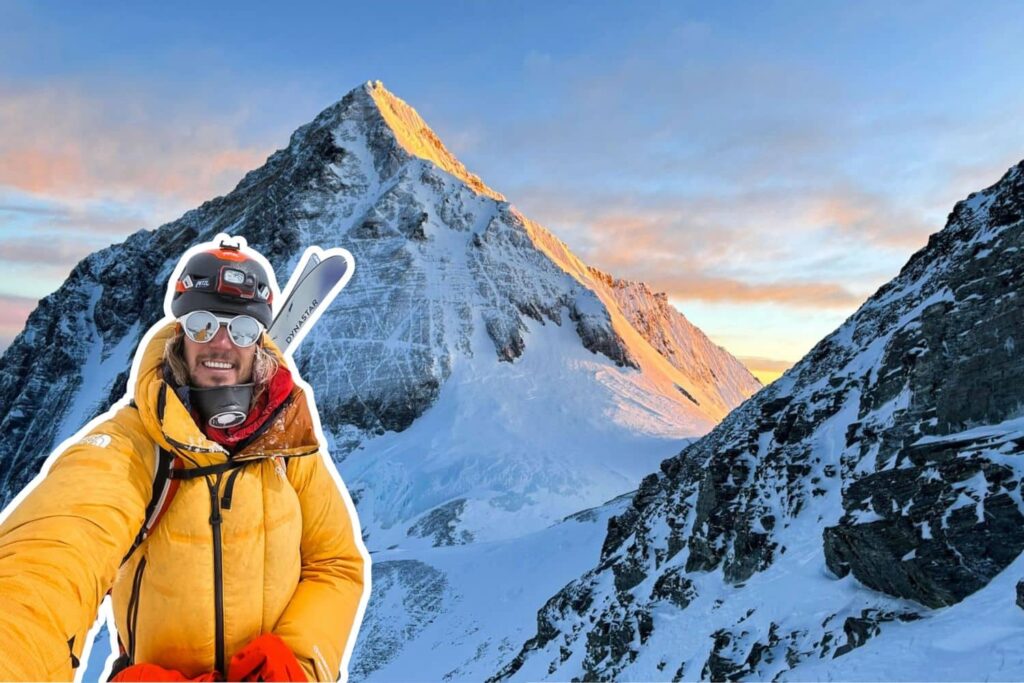
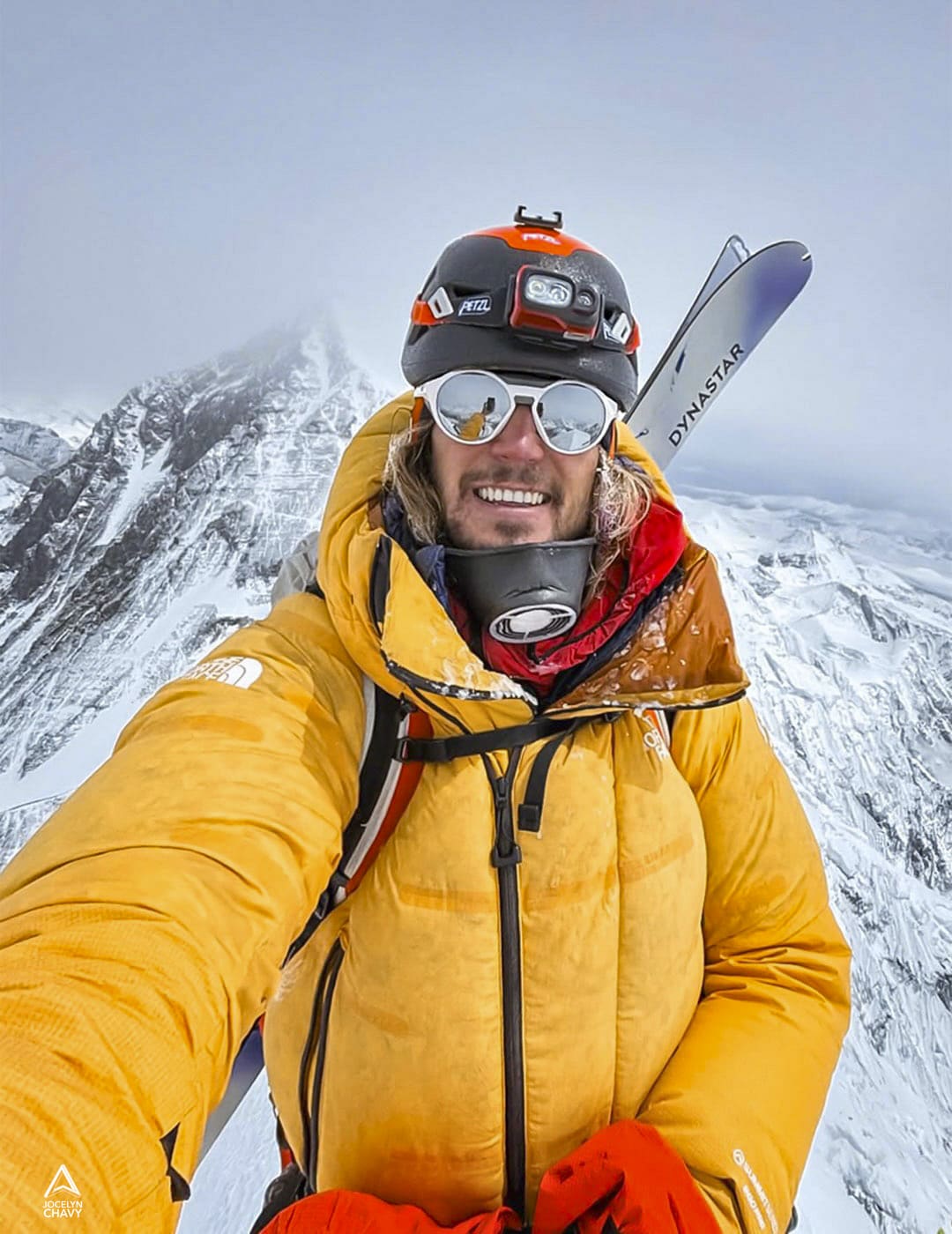
On May 12, Bartek Ziemski reached the summit of Lhotse, at 8,516 meters, before strapping on his skis to descend to base camp via the extremely steep west couloir, dubbed “the dream line” by the first and only other skiers—Americans—in 2018. Without supplemental oxygen, without a Sherpa, and without fixed ropes installed all the way to the summit, in extremely difficult snow conditions, the Polish climber achieved a solo feat and a major milestone in the history of Himalayan skiing.
Lhotse is the fourth-highest peak in the world, located near Everest. Its standard route is anything but standard: it shares the Icefall, the West Col, and part of the Lhotse face with the Everest route before heading toward its own terminal couloir—a high, steep, steep-walled line.
This couloir joins the summit ridge of Lhotse, whose south face plunges into one of the planet’s greatest abysses—a three-kilometer wall, to say the least. Suffice it to say that simply putting on skis at the summit of Lhotse is already a feat in itself: so what about doing it alone and without oxygen? This gives an idea of what Bartek Ziemski accomplished: true Himalayan mountaineering.
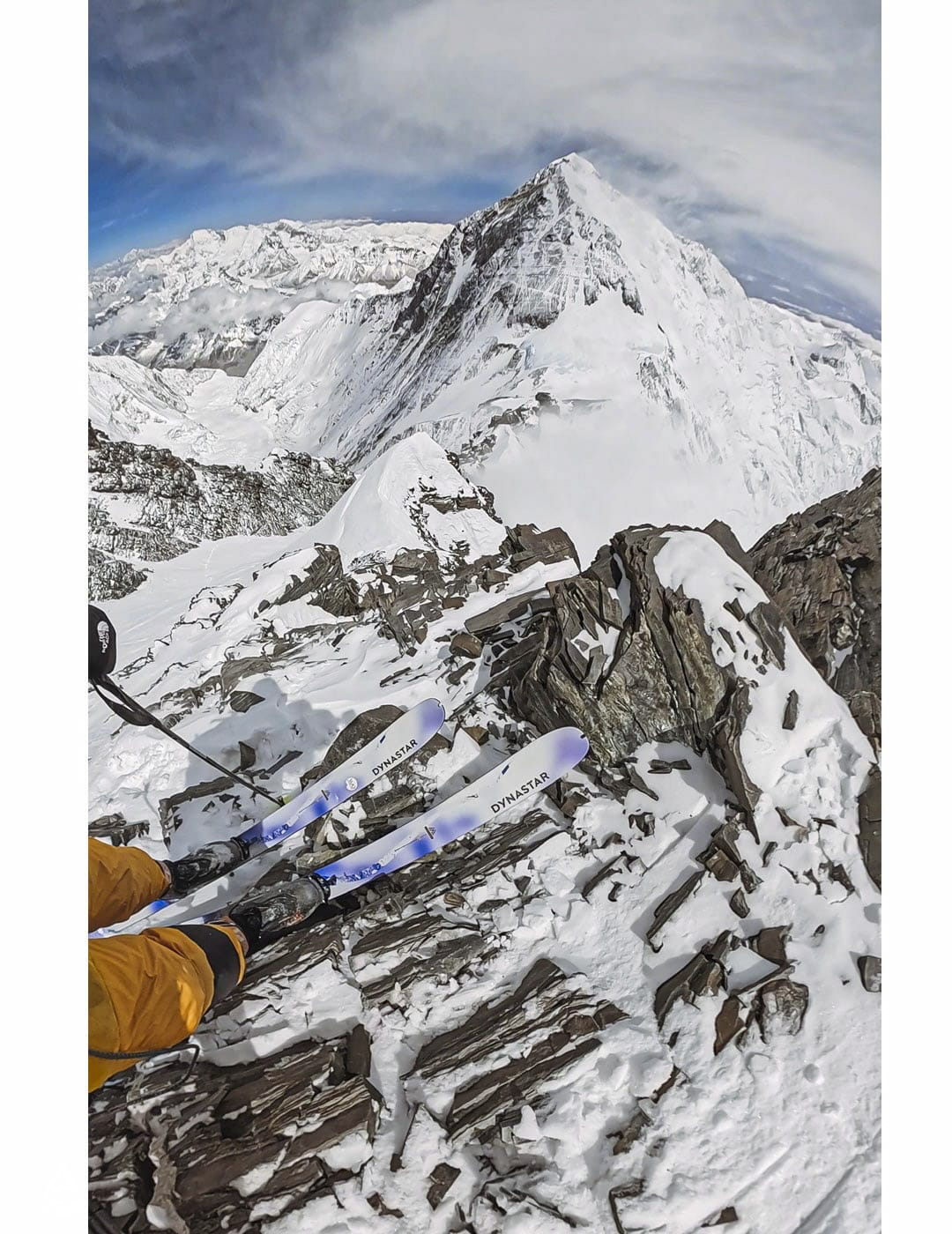
©Bartek Ziemski
On May 12, around noon local time, Bartek Ziemski reached the summit. As the Polish Mountaineering Federation reports, he was alone, without an oxygen tank, ahead of the teams tasked with installing fixed ropes in the upper section and ahead of the bulk of the season’s commercial traffic. A few minutes later, at 12:14 p.m., he began his ski descent from the fourth-highest peak on the planet.
The ascent took place during a very narrow weather window. After an acclimatization rotation with nights at Camp 3, Ziemski allowed himself only one day of rest before setting out again. The timing is dictated by the weather: another spell of strong winds is forecast, and the opportunity may not present itself again.
From base camp, Bartek ascends to Camp 3, then the next day to Camp 4, taking a short rest before setting off for the summit around midnight. Above, there were no established tracks. There were still no fixed ropes in the final section, except for the old ropes from previous years. The Himalayas, 1980s-style, without crowds or sherpas. Ziemski was alone, and he was the first of the season to summit Lhoste.
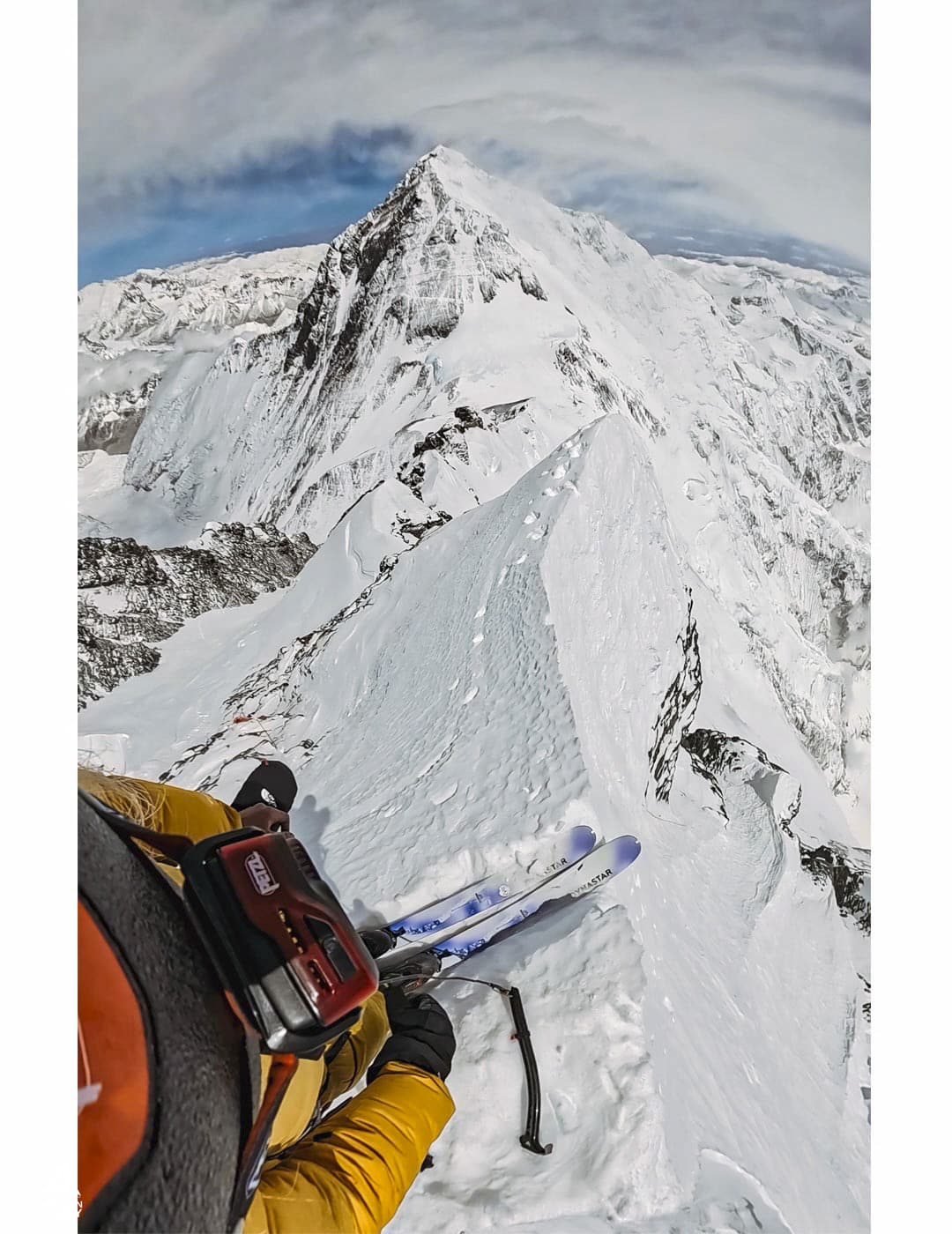
On the summit ridge, facing Everest. A stunning photo showing the Kanshung Face of Everest (east, on the right) ©Bartek Ziemski
As for the snow, it was anything but easy. The Polish Federation described the conditions as “for connoisseurs”: fresh snow in places, hard-packed snow throughout much of the couloir, icy sections, wind-sculpted snow slabs… in short, the kind of conditions where every turn counts. In their photos, compared to the first American ski descent by Hilaree Nelson and Jim Morrison, they had benefited from better snow conditions, and above all, a better fill in the Lhotse Couloir. And for good reason: they completed the descent—with oxen—in the fall. On May 12, Bartek had no room for error.
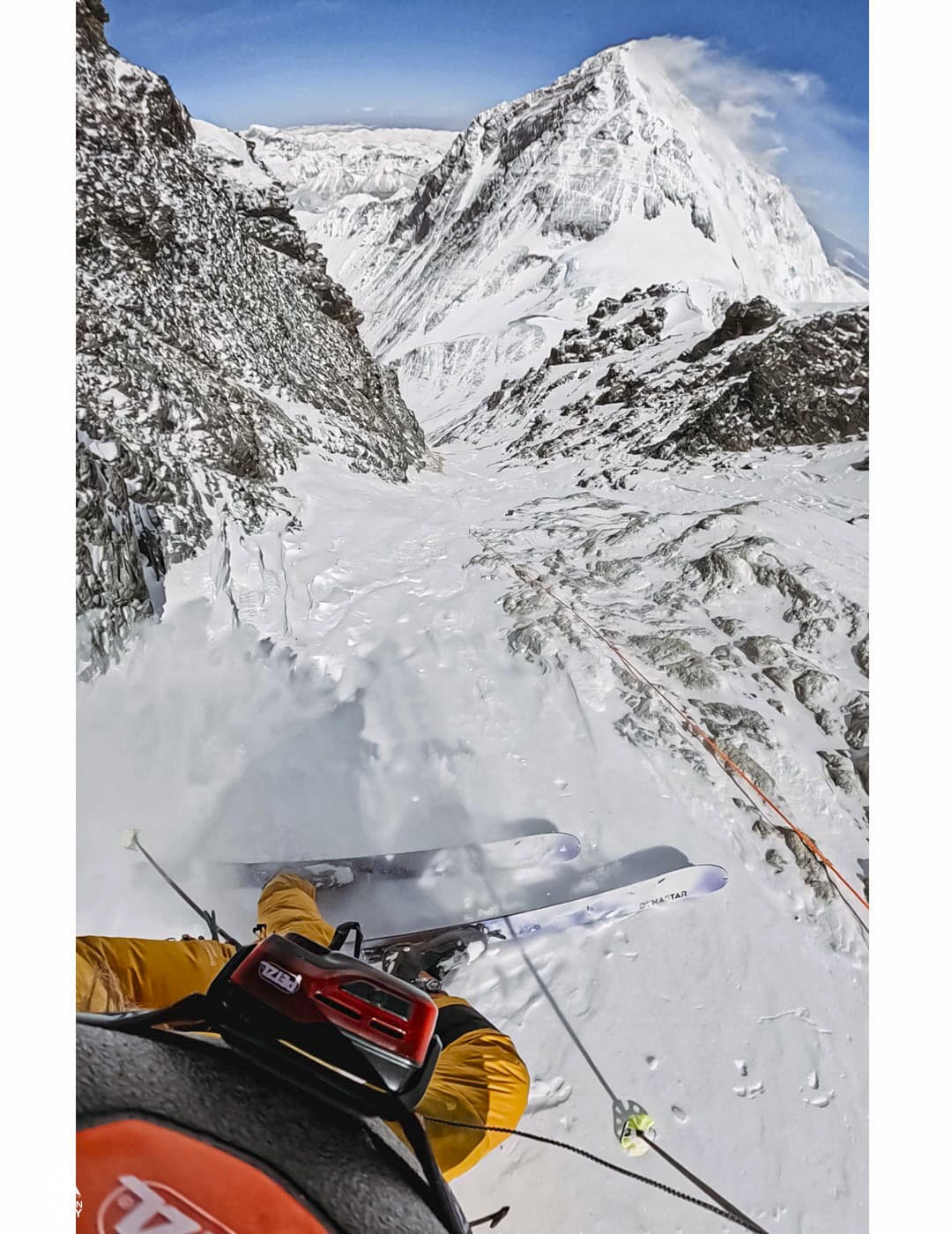
©Bartek Ziemski
Ziemski reportedly managed to ski all the way to the Ice Fall without taking off his skis. There, a large crevasse blocked the path. Rather than risking exposure to an area threatened by seracs, Ziemski climbed a metal ladder on skis, according to the Polish account, before continuing on to Base Camp. The detail is almost absurd, but it speaks volumes about the Pole’s unwavering determination.
Here again, the comparison is revealing, both with the Americans of 2018 and with Andrzej Bargiel, who skied down Everest in September 2025: Jim and Hilaree, as well as his compatriot, all benefited from a dedicated team of sherpas.
©Bartek Ziemski.
Bartek Ziemski, 30, didn’t just come out of nowhere. A native of Bielsko-Biała, in southern Poland near the Silesian Beskids, he learned to ski at a very young age before discovering the Alps while studying at the Warsaw University of Technology and later in Salzburg. He became involved with the youth group of the Polish Mountaineering Federation, the Klub Wysokogórski SAKWA, and later the Polski Himalaizm Sportowy program, which supports the new generation of Polish Himalayan climbers.
Since 2022, he has been pursuing the MAD Ski Project: climbing and then skiing the 8,000ers, in the best possible style. Broad Peak and Gasherbrum II in 2022; Annapurna and Dhaulagiri in 2023; Makalu and Kangchenjunga in 2024; Manaslu in 2025; Lhotse in 2026. Eight 8,000-meter peaks skied down, all without oxygen.
The Polish Federation also notes that Dhaulagiri and Kangchenjunga were historic first ski descents, accomplished with Oswald Rodrigo Pereira, a climbing partner and filmmaker, who filmed while Ziemski skied down.
This Lhotse adds another layer. Not just because it’s the eighth. But because it combines extreme altitude, steep slopes, commitment, relative solitude, no oxygen tanks, and poor conditions.
In today’s Himalayas, Ziemski reminds us that an 8,000-meter peak can still be climbed and skied down with a certain simplicity. His Lhotse, in any case, is a total feat, one that has just added a new chapter to the history of high-altitude skiing.